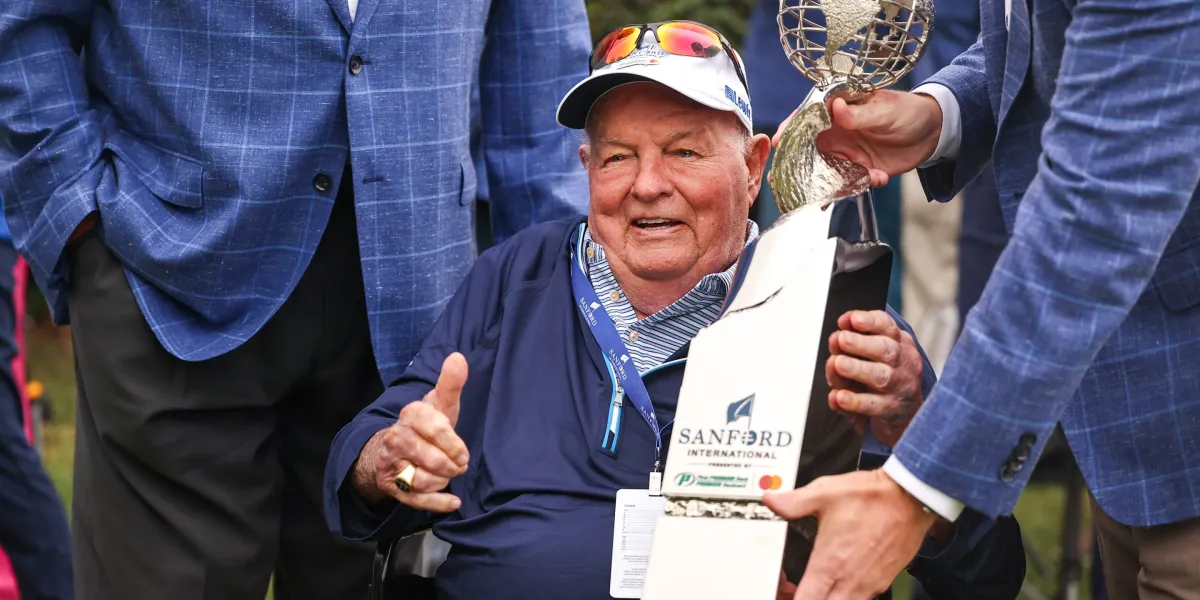
The South Dakota banking magnate spent decades giving away his fortune, and by the end he had parted with more than $4 billion, $2 billion of which went to his namesake health system. The billionaire philanthropist died July 18 at age 90. As of March, his net worth was estimated at $2.4 billion.
Read more Types of mortgage loans: A guide to choosing the right one
“I want to die broke,” Sanford told Forbes in 2007. “Very plainly, very succinctly, I look at life as an investor. What will give me or my community the best return?”
His donations turned a small regional hospital into one of the largest rural health-care networks in the country. That made him the “greatest philanthropist in South Dakota history,” according to South Dakota Gov. Larry Rhoden.
Sanford gave across the state, which resulted in the Sanford Underground Research Facility, a major state asset in science and education; the Build Dakota Scholarships and the Premier/Freedom Scholarship, which have gone to thousands of young people; the Sioux Falls Development Foundation; and the Children’s Home Society of South Dakota, where he was the biggest donor, according to the governor’s office.
“Beyond his high-profile gifts, Denny was a key reason that Sioux Falls has such a strong culture of philanthropy, and many important community improvements benefited from his support,” Lt. Governor Tony Venhuizen said in a statement. A 2024 study by FinancialPlanning ranks South Dakota as the ninth-most philanthropic state in the U.S., based on philanthropic giving, volunteering, and service rates.
How Denny Sanford made his fortune
Sanford grew up poor in St. Paul, lost his mother to breast cancer at 4, and started working in his father’s garment shop around age 8. He used to call a teenage brawl that landed him in jail—and a judge who sprang him to enroll at the University of Minnesota—the best thing that ever happened to him, according to a profile of him by a local publication. He went on to study there and forged a formidable career in finance afterward.
Sanford’s money came from a somewhat unglamorous corner of finance. He bought a Sioux Falls bank from a friend in 1986, which became First Premier Bank. He made his fortune from its credit card arm, Premier Bankcard, which issued high-interest cards to people with bad or no credit, a practice made possible by South Dakota’s lenient banking laws. The business was lucrative enough to push Sanford’s net worth past $3 billion, according to a local publication.
To be sure, Sanford never pretended the cards were cheap. He called them a lifeline for credit-impaired customers, who still paid $175 in fees for a $1,000 credit limit, according to the 2007 Forbes profile of Sanford.
Having made his fortune, Sanford made it his mission to give it away. In 2007, Sanford handed $400 million to a small regional health provider—the largest gift to a health system in U.S. history at the time. The provider took his name, and other checks built Sanford Health into a Midwest powerhouse of hospitals and clinics. His giving to the health system ultimately totaled about $2 billion.
The giving spread far past the Dakotas. From La Jolla (a neighborhood in San Diego), where he later lived, Sanford poured millions into UC San Diego, the Sanford Consortium, and the San Diego Zoo and Safari Park.
The Chronicle of Philanthropy named him one of the 50 most generous philanthropists in the country, a list he made repeatedly. In 2025, he ranked No. 14 in the U.S., having donated $321 million.
His record does carry a shadow. In 2020, ProPublica reported Sanford was under investigation for possible possession of child pornography. Investigators obtained search warrants, and the case was referred to the Justice Department. Unsealed court records later alleged image files tied to an email account linked to Sanford. His lawyers said others had access to his devices and cited signs of hacking. In 2022, South Dakota’s attorney general declined to file charges, finding no prosecutable offenses within the state’s jurisdiction. Sanford signed the Giving Pledge in 2010 and was removed from it in 2023 after the investigation.
Still, Sanford leaves behind a legacy of extraordinary giving. He was long set on giving away his money while he was alive, rather than leaving it to a foundation to perpetuate his wealth.
“He could have done many things with his money, yet he reinvested it in South Dakota,” Premier Bankcard CEO Miles Beacom said in a statement.
Read more JD Vance becomes first sitting vice president to welcome a child in office in over 150 years
About the Author