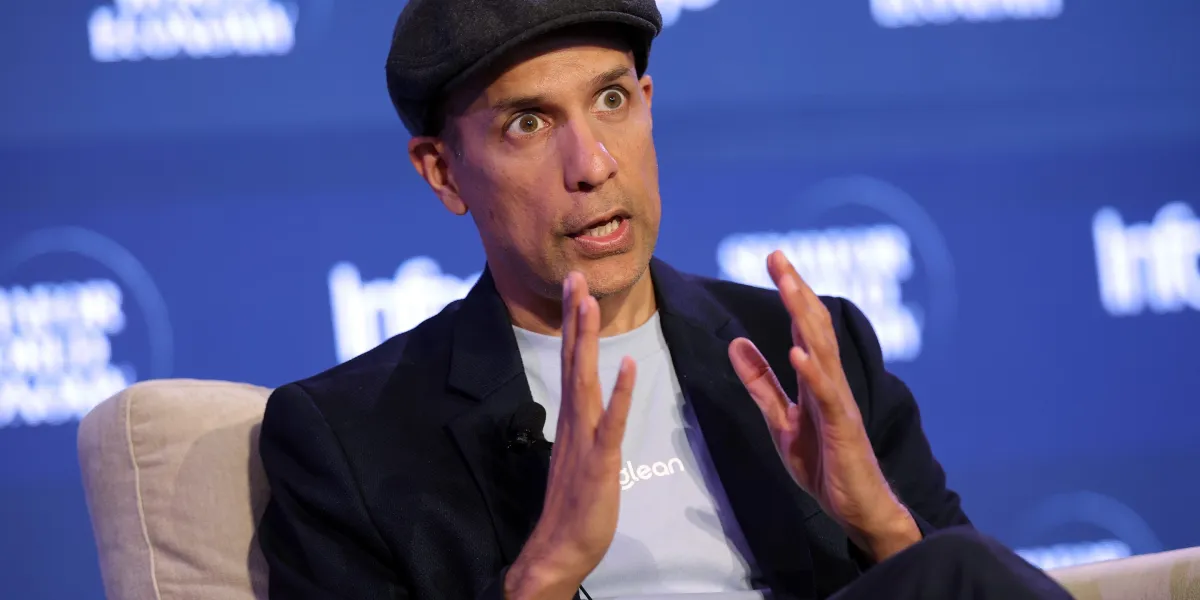
“There are certain things in the U.S. today that are challenging,” Jain told Fortune. “But I think it remains the land of opportunity. It remains the place where entrepreneurship is celebrated.”
He would know. Jain left a small town in northern India, Jaipur—where, by his own account, 95% of people never left—moved to America in 1986 with nothing but an engineering degree and went on to become one of Google’s distinguished engineers before co-founding not one, but two unicorns: The cloud data company Rubrik and, most recently, Glean, currently valued at around $7.2 billion.
America may be grappling with rising costs, political instability, and a growing distrust of its institutions.
But Jain insists it remains the only place in the world where anybody can become somebody with a billion-dollar company (or two), like him.
“You can just graduate from college, have no experience, but if you have an idea, you will find people who will be willing to invest in you,” he said. “I think all of those things remain intact.”
Americans are escaping the U.S. at a rate not seen since the Great Depression
The numbers tell a stark story. The U.S. recorded a net negative migration of between 10,000 and 295,000 people in 2025—the first time in at least 50 years that more people moved out than moved in, according to The Brookings Institution. To put that into context, negative net migration hasn’t happened in the U.S. for almost a century, not since the Great Depression.
Up to 405,000 left voluntarily, pushed by a volatile political climate, an immigration crackdown, and a cost of living that is squeezing even high-earners on six-figure salaries.
Nearly 9 in 10 of those attending this May’s Move Abroad Con—where 600 Americans gathered specifically to plan their exits—blamed the government, Expatsi co-founder Jen Barnett told CNBC.
In fact, searches from U.S. users for “move to Canada,” “move to Italy,” and “move to Portugal” spiked overnight on the evening of the Trump vs. Biden debate in June of 2024. The biggest spike of those searches occurred when President Trump was first elected.
Ex-OpenAI researcher Miki Habryn didn’t want to leave—but felt she had no option: the engineer, who had a six-figure salary, a San Francisco home, and a dream job, packed up her family and moved to Stockholm, saying she couldn’t sleep at night under Trump’s America.
“I just got to the point of: It’s time to go, I can’t just stay here and do nothing, but doing anything comes with such terrible risks for me because of my status,” Habryn previously told Fortune. “During the campaign, it was immigrants and transgender people that was occupying the airways, and since I’m both, they’ve got me coming and going effectively.”
Read more Meet the 2 men putting New York’s $300 billion pension fund in play for the first time in 20 years
Many others have fled America in search of adventure, growth, and more money in their pocket at the end of the month, according to Barnett. And at the same time, fewer people are moving in: migration fell from 2.7 million in 2024 to 1.3 million last summer.
Jain has noticed it too. “Fewer people are making the decision to actually come to the U.S. these days,” he said, while adding that he’s seeing a big dip in the number of international students choosing American universities.
But in his eyes, there’s never been a better time to move there—especially as AI turns Silicon Valley into the center of gravity for the global economy.
“Maybe we’re in a bubble, but I live in Silicon Valley, and this is the land of innovation today,” he added. “AI is the big thing—that’s it. Most startups in that space are getting formed here.”
From Nvidia to AMD, Silicon Valley’s most powerful CEOs have one thing in common: they weren’t born in America
If you wanted more proof that the American dream is alive and well, then look no further than the CEOs of some of America’s biggest companies—many of whom weren’t born there. Like Jain, they were able to build lives and companies far bigger than anything their birthplaces could have offered them.
Jensen Huang was born in Taiwan and briefly raised in Thailand before immigrating to the U.S. at age 9. His first job was washing dishes at Denny’s, and he went on to found Nvidia—now the world’s most valuable company. His cousin, AMD chair and CEO Lisa Su, also immigrated from Taiwan at age 3 and turned the struggling chipmaker into an $876 billion AI powerhouse.
Dan Rogers, the CEO of work management platform Asana, escaped the U.K. for a better career in the U.S. He planned his Stateside move from the age of 14, working his way through Dell, Microsoft, Amazon Web Services, Salesforce, and ServiceNow before landing the top job in San Francisco.
His explanation for why he wanted to work in the Bay Area is basic math; he told Fortune: “I looked at the Fortune 50 AI list, 30 of the 50 are in the Bay Area. There is this inordinate concentration—and because of that concentration, it is self-reinforcing.”
Ambitious people know where the hottest tech companies are, so they flock there—as do investors. And so it continues to become a hotbed for innovation. Or the no.1 destination for anyone looking to turn an idea into an empire.
“Silicon Valley was, and is once again, with the AI companies, a real magnet for something special, for people that want to have an outsized impact,” Rogers said, adding that “the hive of activity, the obsessiveness, the quality of talent, the access to funding and new ideas is second to none.”
About the Author