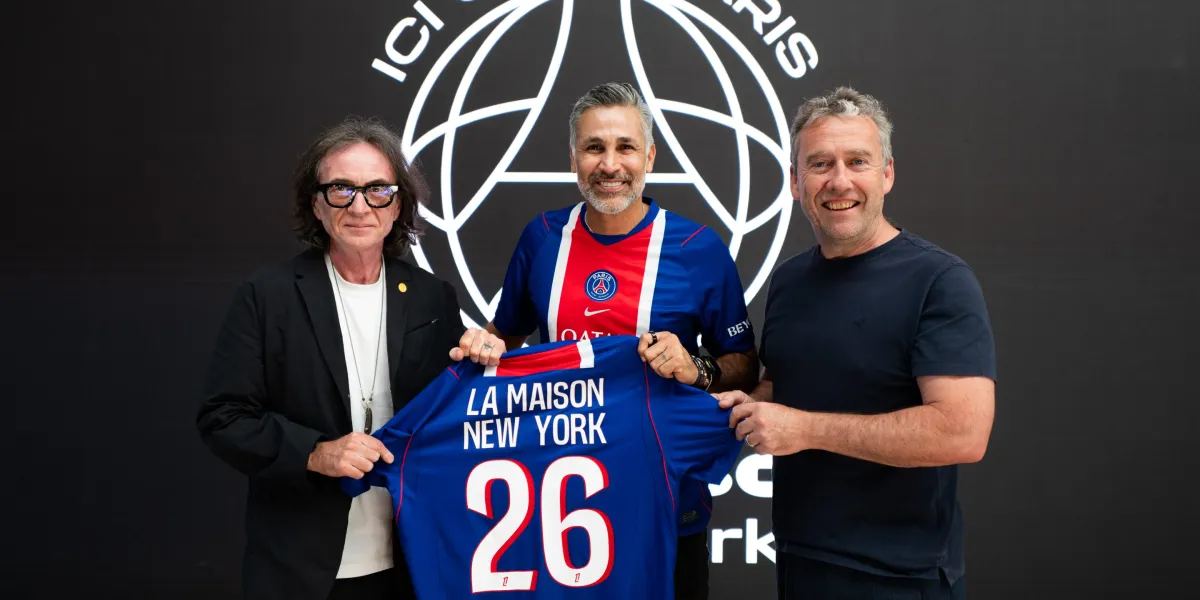
Fifty-seven years later, in a pop-up event space on Union Square in New York—French chefs in the kitchen, artists’ limited-edition collaborations on the walls and a France-Senegal World Cup watch-along on a big screen—Paris Saint-Germain is attempting something audacious: turning that motto into a business model.
Chief Revenue Officer Richard Heaselgrave, a West Bromwich Albion supporter from the English midlands, gestured around the New York activation during the World Cup and said that World Cup game notwithstanding, “there’s no football here.” He described the balance of sport and commerce as a “yin and yang” kind of dynamic: “Paris, as a city, is appealing: The food, the art, the culture, the fashion, that we can export.”
“This is literally the brand I’m talking about.” He pauses. “We sell out. These are profitable ventures. We don’t spend money on this.”
It is, depending on your vantage point, either the most sophisticated evolution in sports franchise history or the most expensive stress-test of a question no one has yet answered: Can “more than a club” be engineered from the top down? Or does it only emerge, as it did in Barcelona, from the bottom up—from suffering, from identity, from something that cannot be purchased?
PSG’s La Maison in New York has its own motto, of course, one as revealing in its own way as mes que un club. “Ici, c’est Paris.” It roughly translates to “here, this is Paris.”
The 15-year project
When Qatar Sports Investment took over the sleeping giant of French football in 2011, PSG had no jersey in the streets of Paris. “I can promise you,” said Fabien Allègre, PSG’s chief brand officer, who has been with the club since 2008, “when I started to work with Paris Saint-Germain, I can promise you that [there was] no PSG jersey in the street of Paris.”
Fifteen years later, the club is sitting on top of the club football world, having won back-to-back Champions League titles and boasting 240 million fans globally—90% of them outside France.
The chairman had stated his ambition from day one in broad terms: Make PSG global, “the most important franchise in sport,” and simultaneously a global brand. Allègre, speaking with a thick French accent and peering out from behind thick black glasses, framed by a multicolored design around the eyes, said he “had at the time a lot of questions” about this goal.
The example he took away, he shared, was the iconic New York Yankees cap, a dark navy blue with a distinctive angular, interlocking logo that speaks for New York City as a brand, more than a club in the Bronx. “Every single person going to New York buying a hat, I mean, 80% of them didn’t know that that was like a baseball team,” he said.
When Fortune noted the current ubiquity of the PSG brand—including in navy blue baseball caps—Allègre acknowledged the badge was redesigned in 2013 to little opposition. Football fans are notoriously finicky about club symbols—Arsenal fans, for example, still debate the direction their iconic cannon faces on the badge—but Allègre said this change was “smooth.”
The club retired the cradle of Louis XIV from its badge—a symbol of Saint-Germain as a suburban town 20 kilometers outside Paris, where the kings once lived. In its place: the Eiffel Tower, redrawn and modernized, and the fleur-de-lis. The message was explicit. “It’s like, okay, let’s capitalize on Paris,” Allègre said. “Make it bigger than Saint-Germain. The cradle of the king—that was Saint-Germain … Nothing to do with us.”
Allègre said the club was clear with fans about its intentions and there was little uproar: “Now there is a global brand that also represents Paris, without a confusing king’s cradle in the mix. “People understood,” Allègre said.
Paris as the product
The strategic foundation, PSG executives told Fortune, is the city itself. PSG’s brand executives are emphatic on this point: They are not selling football. They are selling Paris.
“L’art de vivre,” Allègre said. “The way of living. That’s really deep into all Parisian people.” It is a cultural inheritance no rival can replicate—not Manchester City, not Real Madrid, not Bayern Munich. Paris cannot be manufactured.
Heaselgrave made the same point from a commercial angle: 40 million tourists visited Paris last year, he noted, without any help from PSG. “If we can take Paris on,” he said, “the football fans, doesn’t matter who they support, will become… we don’t have a word for it in Europe. People that like the brand can have some kind of warmth towards us, whether you support us or not. That’s the crucial difference for us.”
This explains PSG’s approach to partnerships. Dior dresses the players for every official appearance—not as a sponsorship decoration but as a statement of aesthetic register. Jordan Brand, entering its tenth year of collaboration with PSG next year, took the club into a cultural conversation that had nothing to do with France’s Ligue 1.
Allègre proudly noted a recent kit design from Jordan brand that echoed the famous Chicago Bulls of Michael Jordan’s heyday. “This specific collection, when we launched it, was really elegant,” he said, noting that like the badge, it went away from the club’s traditional look, with no red stripe down the middle of the shirt, but only a dark blue and the Bullsian diamond on the shorts. “For me, that was a good example of the balance that you need to find,” Allègre said.
A subsequent kit design was another “big swing,” he added, a tricolor with blue, red, and white: “That was a signal that it’s not only a Parisian team. You know? It’s, like, we represent, in a way, on the European scene, French football as well.”
The aesthetic philosophy runs through every decision, including ones that might seem trivial. “The choice is driven by the purpose of the creation,” Allègre said. “Now the jersey’s everywhere, but it was not fashionable for a long, long time.” When asked about the current story of the PSG brand, Allègre said the on-field success was massive. “For me, it’s like the 1 plus 1 equals 3. So I don’t know what’s going to happen, but what I’m sure is that it’s not going to stop now.”
The venture thesis
If the brand work is the front stage, PSG Labs is the backstage infrastructure—and it is unlike anything in professional sports.
Launched one year ago, PSG Labs is run by Par Helgosson, a Swedish-born tech veteran who has been with the club for three years, brought in originally as head of Web3, Digital Assets, and Metaverse. The mandate evolved into something more structurally ambitious: a hybrid accelerator, venture fund, capital-raising platform and go-to-market infrastructure, running four quarterly deal batches per year.
The investment thesis is built on an inversion he calls “market before product.” Rather than backing startups speculatively and hoping for product-market fit, Helgosson said PSG Labs identifies genuine internal business needs—across men’s football, women’s football, handball and judo—and seeds ventures to fill them. “We look for things in our business that might want to be updated or that we want a better product,” he said.
The pitch to founders is the 240 million fans: “No matter if you have capital or not, there will be a few things moving forward that will be absolutely critical,” he tells them. “Relevance, access, distribution, trust, sexiness, coolness. And capital access. It’s much, much harder to build than to raise capital or build a technical product.” PSG provides all of those things as infrastructure.
Wall Street has noticed, he said, while declining to share the names of any particular partners in financial services. “We’ve got a lot of big players in the Wall Street ecosystem, because Wall Street now has also discovered two things that we’re at the intersection of,” Helgosson claimed. First is that sports assets are not a passive asset anymore: Investors can invest and get meaningful returns in the sports space. Second, he claimed, is that Wall Street and Web3 and crypto digital assets are all “going to run on a tokenized route,” meaning that PSG is a crypto-friendly platform housed within a mega-successful sports club.
PSG, notably, is already the only major football club in the world to hold Bitcoin on its balance sheet.
Helgosson made a broader claim that cuts to the heart of what PSG is attempting. “Through this lens,” he said, “buying your own distribution—to own your own distribution in the future with AI arriving—all sports IPs from that lens is undervalued.”
The conventional wisdom in sports finance is that American franchises—the NFL, NBA, MLB—are grotesquely overvalued by any traditional metric. Helgosson is arguing the opposite: In an AI era where distribution is the scarce asset and the cost of building product approaches zero, a club with 600 million fans is not a sports franchise. It is a media platform, a venture accelerator, and a consumer brand simultaneously—and no one has yet priced that correctly.
The global Ici C’est Paris La Maison tour, which includes PSG Labs, reflects the ambition: Shanghai, Tokyo, Los Angeles, New York, Doha, London, Paris. Seoul is next. “No one runs four batches a year,” Helgosson said of rival clubs. “No one.”
The Barcelona question
The footballing establishment has not been slow to notice what is happening on the pitch. Jonathan Wilson, the game’s foremost tactical historian, argued in his May 2026 Substack piece “The Golden Age of Paris” that PSG under Luis Enrique has inaugurated a definitively new era in European football—the first such era, he contends, since the one ended by the club that said it’s more than a club: the Barcelona of Lionel Messi and Pep Guardiola.
Wilson dates that ending to their Champions League semi-final defeat to Chelsea in 2012, with a possible extension to the (Luis Enrique–coached) Barça side that beat Juventus in the 2015 final. Real Madrid, he notes, are winners too often to own an era—they are “the default, the team that wins when nobody else does.” PSG, by contrast, now have both the trophies and something rarer: a coherent identity.
The irony Wilson surfaces is sharp. PSG were long seen as the antithesis of footballing virtue—a petrodollar project built on superstar acquisition rather than philosophy. But Luis Enrique’s side, with Kvaratskhelia, Dembélé, and Doué pressing collectively and sacrificing individual glory for system, now best embodies the collective, tactically coherent ideals that Guardiola’s Barcelona originally championed. The club that was accused of buying its way to relevance has, on the pitch, earned it.
Wilson’s broader structural argument—developed across his book The Barcelona Legacy (2018) and his more recent work on Manchester City—is directly relevant to what PSG’s executives are building off it. Qatar’s investment in PSG, and Abu Dhabi’s investment in Manchester City, were attempts to recreate the magic of the Guardiola Barcelona team that the world fell in love with. Guardiola himself just wrapped up an epic 10-year reign at Manchester City that included many trophies—and much debate about whether his teams were truly as magical as his work at Barcelona.
Can it be earned?
The Guardiola-Messi era of Barcelona was the proof of concept for the més que un club vibe, not the origin. The motto described something that already existed.
PSG’s project runs in the opposite direction. The chairman arrived in 2011 with a vision and the capital to execute it. The brand strategy, fashion partnerships, Jordan collaboration, Labs venture platform and Union Square pop-up are the yang to the football club’s yin. PSG is very consciously more than a football club and when it says “ici, c’est Paris,” it truly is bringing a slice of Paris everywhere.
Allègre was candid about the fragility of what they’re building. Gen Z fans, he said, are highly volatile—and they “know when a brand lies to them.” The challenge is not acquisition. It is retention. “My challenge,” he said, “is to make a loved brand—what we are—into a brand for life.”
Heaselgrave framed the risk in starker terms. Clubs that define themselves purely by on-pitch results are, he said, “going into a casino.” The model of buying players, winning trophies, and monetizing the resulting fanbase is a bet that pays out inconsistently and collapses without warning. “If we suddenly go, ‘We won the Champions League, we’ve got loads of fans’—and then we lost … that’s going into a casino. Why would you do that?”
The back-to-back Champions League wins, then, function differently for PSG than they would for most clubs. They are not the source of the brand. They are validation of an infrastructure designed to survive without them.
Whether PSG can actually deliver on that thesis remains the open question. The club is one year into PSG Labs, 15 years into the broader brand project, and still operating in a country where broadcast television revenue—the financial backbone of English and Spanish football—is dramatically lower than its rivals. Scrutiny about financial fair play, the regulations introduced to ensure that deep-pocketed owners such as Qatar and Abu Dhabi cannot overly distort the playing field, has not disappeared for either PSG or Manchester City. (The club declined to comment on any financial fair play questions to Fortune.)
But Barcelona’s famous motto took decades to mean what it means. PSG is trying to compress that timeline with capital, strategy, and the most famous city in the world as its brand foundation. A representative for PSG confirmed to Fortune that PSG considers itself to be a brand in its own right — more than a club.
Read more Anthony Scaramucci on America 250: where have you gone, Joe DiMaggio?
“We are daring to be curious,” Helgosson said. “We would like to be first.”
In the post-AI era of sports, that may be the only business model that matters.
About the Author